
Communion
On devotion

“ … for the growing good of the world is partly dependent on unhistoric acts; and that things are not so ill with you and me as they might have been, is half owing to the number who lived faithfully a hidden life, and rest in unvisited tombs.”
George Eliot, Middlemarch
Tuesday April 1, 2026. A really good risotto with JLH in an Italian restaurant in Cumbria’s so-called border city, Carlisle. It’s the Easter school holidays, and great to see the restaurant full with families. After my friend had done a somewhat overdue grocery shop, there are no shops or public transport back in the village where we live, I drove him to the city hospital where he’d an appointment in ophthalmology. I sat in the waiting room in that department next to a retired couple who vented that their mother, ninety-six and in a wheelchair, had been in triage for coming up on three hours.
“What about you, have you travelled far?” the man said.
And so began a conversation which I hope helped them to forget some of their frustrations with an understaffed hospital, and for me to answer questions about the village where I live with M and our son. The couple lived in Carlisle but had, originally, lived just ten miles away from the village.
Life, these past six months, has involved several visits to hospitals and the GP’s surgery while JLH wasn’t able to drive and, as I considered this, because he’ll be driving again in a matter of weeks, I thought again about how quickly the months have gone. The day JLH can drive again is the day of my husband’s sixty-fifth birthday, how can it be five years since we celebrated his birthday during lockdown? eighteen months since we went to Cornwall on my sixtieth? We’ve been thinking of how, when we move back down south, we’d like to live somewhere close to a GP practice, a bus route…
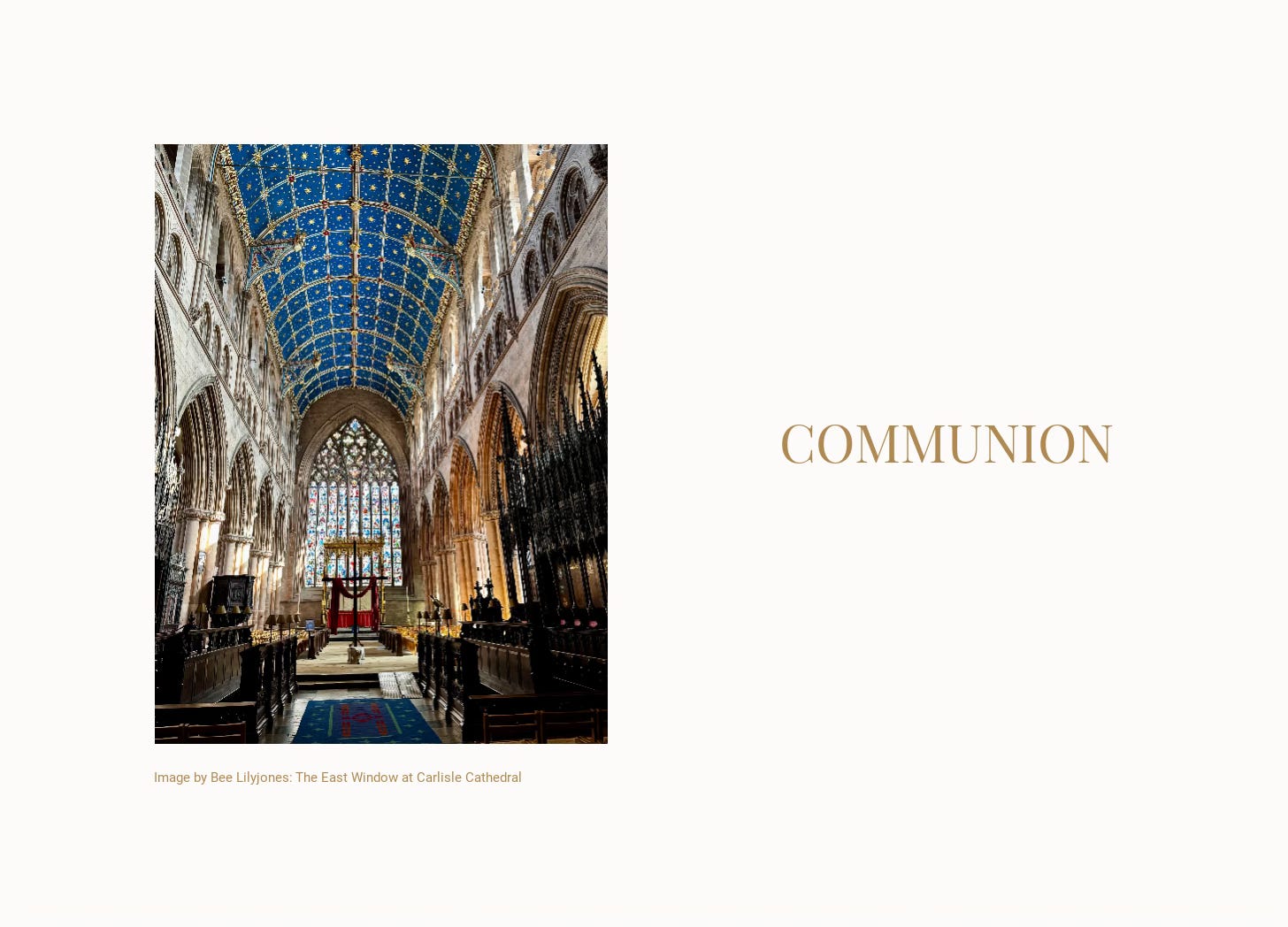
Wednesday April 2, 2026. Here I am in Carlisle again, with my husband M, this time. We had breakfast, wandered around a gallery and museum and onto Carlisle Cathedral to ooh and aah at the cobalt and gold ceiling and the recently voted Nation’s Favourite Stained Glass Window.
“One of the largest and most complex examples of Flowing Decorated Gothic tracery in England. Its origins can be traced to the lengthy rebuilding works of the fourteenth century that followed a fire which took place in 1292 – lengthy because of frequent raids on the city by the Scots and because of recurrent outbreaks of the Black Death that killed at least a third of Carlisle’s population.”
I’d stood in the cathedral for a good while considering a marble plaque carved with a sunflower, a dove and a rose, dedicated to the memory of Catherine, daughter of Humphrey Senhouse of Netherhall, Esq. and Mary his wife. Catherine died, at the age of twenty-three, in September 1757.
Humphrey had inherited the Netherhall and Ellenborough estates, “and began looking at developing his own coal trade, via the little harbour at Ellenfoot, where the River Ellen met the sea. Humphrey had in 1731 married Mary …. In 1749 he promoted a parliamentary bill to improve Ellenfoot, and a new town was laid out there, named ‘Mary Port’ after his wife.”1
Matthew Hall, who was born in the village where we live, had tutored the Senhouse children for a time before becoming a rector in the West Cumbrian village of Ponsonby. I feel sure that, when Jane and Matthew’s son was born, it would have been Matthew who said the child would be called Humphrey Senhouse Hall (1787-1827). Not a blood connection but an act of deference and of aspiration. I see it as the name of a prominent local family impressed into a child like a letter of introduction he might carry his whole life.
Matthew’s parents, Joseph and Anne, and their parents before were established in the village in the 1600s and likely before. Their family name is here until the 1930s when they were farming The Beeches, opposite and along the way from our cottage.
Rev. Matthew and his siblings I’ve been thinking about a lot lately. There was Ann, who I can’t find anything about yet, and there was John, who married young Mary Carter by licence, hanged himself in a barn the following year, 1777. Captain William Hall of the Bombay Artillery died in 1791 at Cannanore, today Kannur, Kerala, having contracted ‘tropical liver.’ Richard (1757-1801) moved to Suffolk and married Elizabeth.2 There was Samuel (1758-1763) and then another Samuel (1764-1836) who married a village girl, Mary Younghusband - another family I’m tracing. Reader, there are a great many Younghusbands. There was brother Joseph too (1754-1808) who married Jane Grayson, he became a surgeon in Yorkshire.
Rev. Matthew’s youngest brother, Henry (1769-1820,) left for Madras and the East India Company in his early twenties. He rose in the ranks to Deputy Master Attendant, a harbour master. Madras had no natural harbour. Ships anchored miles offshore and masula boats fought through the surf to reach them. Henry accumulated property and did business with the Welshman Thomas Parry, one of the most powerful merchant houses in Madras.
M, my husband, a lifetime of working outdoors, and mountain biking, had an appointment in dermatology, having had cryotherapy for precancerous cells last year. This time he was getting a potentially precancerous blemish checked out. He came out carrying a fancy white paper bag, as if he’d had a spa day or stayed in a boutique hotel. But the bag contained cream and printed instructions: photodynamic therapy, a photosensitising agent absorbed by damaged cells.
“They were very exact,” he said. “Two hours in the sunshine to activate it.”
“But...” we both laughed. The weather forecast for the Easter weekend was bringing Storm Dave.
On the way back to the village from Carlisle we discussed what needed doing in the cottage next, and I talked about Henry in Madras.
“He made a life there, fathered four children.”
But I spoke about how the references in all my research make me twitchy, colonialism, empire, uncomfortable truths… I understand, of course, about individual moral responsibilities, that Henry didn’t build the system. It was already running, profitable. A yeoman’s son managing the harbour of a city the British had no right to govern, I can hold that and still want to know him, right? Henry came from an old village family but the farm wouldn’t support them all, and the East India Company offered something the agricultural land in the village could not, the prospect of a fortune. The late 18th century was the era of the nabob, men who returned from India rich enough to buy estates. The East India Company also had its own army, and a military commission there was significantly cheaper and easier to obtain than one in the King’s army. I try to imagine this village boy from the Solway Plain suddenly in one of the most densely populated trading cities in the world.
At home I Googled routes, opened our world atlas and wondered if Henry sailed on an Indiaman from Whitehaven south through the Atlantic, down the West African coast, around the Cape of Good Hope, across the Indian Ocean...
How long would the voyage have taken?
He would have needed a nomination, a patron or connection who could put his name forward. Could this have been Humphrey Senhouse III (1731-1814) whose children his brother the Rev. Matthew Hall had tutored?
On Easter Day 1819, Henry presented a service of communion plate to St Mary’s church here in the village. The Carlisle Patriot reported it.3 Henry’s letter accompanied the gift. “As it has pleased Almighty God to prosper my labours when abroad, during an absence of twenty-six years.” He asks that the plate be “handed down to posterity as a memorial of my reverence for our most holy religion.” The Minister and Churchwardens replied, praising his industry and his zeal.4
I’ve since read that letter many times. I can hear him in it. The formality, etc. But also, Henry was ill, and I think he knew he was dying. The communion plate given that Easter Day starts to look less like a public gesture and more like a man settling accounts while there was still time.
Their names are in Henry Hall’s will, which I’d transcribed at Whitehaven Archive Centre on Wednesday January 21 this year. Mary, Jane, Catherine, Elizabeth Hall - all resident in India at the time the document was signed, in April 1820. Henry was dying when he signed it, dead by November at fifty-one. The will runs to sixteen-odd pages, names trustees, annuities, leasehold parcels of Cumbrian ground, stone quarries, corn tithes. There are consolidated bank annuities, a house on Scotch Street in Carlisle. The four daughters appear twice. Henry’s ‘natural children,’ natural children being a formal euphemism for illegitimate children. That’s why their mother’s name doesn’t appear in Henry’s will.
A bibi was a long-term domestic companion. An Indian woman. She bore Henry four children but the law didn’t recognise her. By the time Henry came home and married Mary Giles in Carlisle in 1817, the East India Company had grown uncomfortable with such things, leaning towards European respectability.5
So Henry came home, and I can only assume the four girls stayed. In 1812 - eight years before his death - Henry had settled 40,000 Sicca Rupees on them by deed in Madras. A formal act witnessed by Madras merchants. I keep thinking about the bibi. Not her name, which I don’t have and will likely never have. It is the measure of her days, I suppose, that I think about, four children, the household she kept, the man who left and didn’t come back. Did she live a long life? Was she relieved Henry had left? Did she wonder if he missed her?
The will also names the Grange here in the village. “All that my Freehold Messuage and Tenement with the Lands thereunto belonging situate at or called the Grange in the parish ....” Grange Farm. Income for the Cistercian monastery. Then the Dissolution, of course, and centuries of private tenure until the Grange landed in the estate of a man who managed a harbour in Madras.
Henry left his “faithful servant from early youth,” George Johnstone, a life annuity of £25 per year, paid in two half-yearly instalments. But Henry handed his wife Mary “complete discretionary power” to withhold that annuity, either in part or entirely, if George left her service or “in her sole judgement” became undeserving. Henry likely intended this as a way of ensuring Mary retained a trusted and experienced servant after his death. But the practical effect was to bind George in a relationship of compliance. Henry rewarded George’s loyalty with a gift, then made that gift conditional on continued loyalty to someone else entirely. It was, whatever the intention, a form of financial coercion written into law. And it placed Mary Giles in the position of enforcer. She didn’t design this arrangement. She inherited it, the power to decide whether a man ate or starved, handed to her as if it were a gift.
Henry’s will ties the Grange into an elaborate settlement, a legal chain designed to hold the estate in the family. His wife Mary for her lifetime, then his brother Samuel Hall of Gilcrux (who didn’t have children,) then cascading down through nieces and nephews in order of seniority. Mind, there was a condition. Every inheritor of the Cumbrian estates must take the name Hall, bear the Hall arms, obtain a Royal Licence to do so, all within six months of becoming entitled. Otherwise they would forfeit as if they had died without issue.
A man who couldn’t give his four daughters in Madras his name in any legal sense, insisting from his deathbed that everyone else carry it.
And they did for a time. Thomas Adcock of Workington, for example, who married Joseph Hall’s eldest daughter Elizabeth, obtained a Royal Licence to drop his own surname and take the Hall name. Their children and their children’s children carried it forward. A family already called Hall, required by Henry’s will to take the surname ‘Hall Hall.’
In St Mary’s churchyard the sandstone is delaminating. Headstones tip forward into the grass. Others lean against the church wall and I don’t know where they stood. The inscriptions on the oldest are smoothing away, letters retreating. I’ve been recording what can still be read, cross-referencing parish registers and documents in the archive centres. The work grows more urgent, every year the weather takes a little more.
Some people are remembered here. Some aren’t. I’m working out what to write about the ones who aren’t.
Online at: https://www.cumbriacountyhistory.org.uk/who-put-mary-maryport-background-maryport Date last accessed: Sunday April 5, 2026
Because of the gorgeous heavy horse The Suffolk Punch I think of Richard as a farmer with a love of horses - just like Mark Sanderson - who also lived at Grange Farm in the village, like Matthew’s family had done. Mark also moved from Cumbria to Suffolk in 1907.
Carlisle Patriot - Saturday 17 April 1819 Online via paid subscription to: https://www.britishnewspaperarchive.co.uk
HENRY HALL, Esq. of Carlisle, on Easter Day, presented a very handsome service of Communion Plate to his native parish …. We feel much pleasure in inserting the following feeling letter from that gentleman, which accompanied the present, together with the appropriate reply of the Minister and Church-wardens.
Carlisle, April the 10th, 1819.
Reverend Sir and Gentlemen, -Observing that the church of my native parish has been hitherto without communion plate, and as it has pleased Almighty God to prosper my labours when abroad, (during an absence of twenty-six years,) I now beg leave, without, I trust, an appearance of ostentation, to present to the church a service of communion plate, to be there preserved, and handed down to posterity as a memorial of my reverence for our most holy religion; and accompanied by my ardent prayers, that all who attend at the communion table of our church may derive that spiritual comfort and consolation, which is promised by our blessed Lord and Saviour to all who believe in him. I have the honour to be, Reverend Sir and Gentlemen, you most faithful friend and very humble servant, HENRY HALL.
St Mary’s, April the 12th, 1819. To Henry Hall, Esq.
“Dear Sir,—We the undersigned, holding at this period the responsible offices of Minister and Churchwardens, beg you, as well in our own names as in the names of the inhabitants at large, to accept our warmest acknowledgments and thanks for the very handsome service of communion plate presented by you to the parish; and whilst we honour the feelings which have induced you to bequeath a lasting memorial of your piety towards God, and veneration towards your native place, we trust this proof of both will be duly appreciated by each class of communicants, and that they and their posterity, emulating not merely your industry, but also your zeal for our most holy religion, may receive the fruits of their labours both here and hereafter.
WILLIAM PATTINSON, Minister.
JOHN PENNY, JOHN BRIGGS, } Churchwardens.
Ref Whitehaven Archive Centre DWM / 505 / 12
Probated Will of Henry Hall of Carlisle, dated 1820
[Date visited: Wednesday January 21, 2026]
Online at: https://blog.royalhistsoc.org/2022/04/04/on-passing-shifting-histories-of-the-anglo-indian-community/ Date last accessed: Sunday April 5, 2026
I think Wills in those times were often used to wield power. Perhaps they still do today in some quarters.
This is another interesting post from you Bee. I very much enjoyed the journey to Carlisle and back.